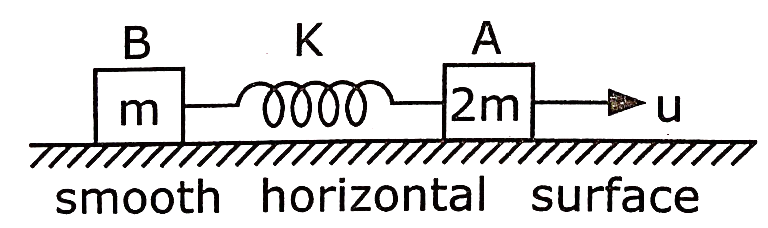
Two blocks  and
and  of mass
  and
and  respectively are connected by a massless spring of spring constant K. This system lies over a smooth horizontal surface. At
  the block A has velocity u towards right as shown while the speed of block B is zero, and the length of spring is equal to its natural length at that instant. In each situation of column-I, certain statements are given and corresponding results are given in column-II, Match the statements in column-I to the corresponding results in column-II :
Column I | Column II | ||
(A) | The velocity of block A | (P) | Can never be zero |
(B) | The velocity of block B | (Q) | may be zero at certain instants of time |
(C) | The kinetic energy of system of two blocks | (R) | is minimum at maximum extension of spring |
(D) | The potential energy of spring | (S) | is maximum at maximum extension of spring |
(T) | constant |




Text Solution
Verified by ExpertsA
If velocity of block  is zero, from conservation of momentum, speed of block
  is
is  . The
. The
K.E. of block  is greater than net
mechanical energy of system. Since this is not possible, velocity of a never be zero.
Since initial velocity of  is zero, it shall be zero for many other instants of time.
Since momentum of system is non-zero, K.E. of system cannot be zero. Also K.E. of system is minimum at maximum extension of spring.
The potential energy of spring shall be zero whenever it comes to natural length. Also P.E. of spring is maximum at maximum extension of spring.
Prepare Smarter with CGP Edu
Get practice questions, solutions, and test series in one place.
Write a Review
Share your experience with this question and solution.
Commentary
Send your comment, doubt, correction, or feedback to admin.
Similar Questions
Explore conceptually related problems